For Hong Kong residents who have built substantial wealth through property, business, or equities, diversifying into the United Kingdom’s Buy-to-Let (BTL) market is a standard wealth-preservation strategy. Cities like London, Manchester, and Birmingham offer predictable, stable, inflation-beating yields. The question remains: how to reduce UK property taxes, given how many there are.
Your UK property portfolio automatically places you within the crosshairs of Her Majesty’s Revenue and Customs (HMRC). You need to report and pay tax on your rental income, stamp duty land tax on any purchases or transfers and capital gains tax on any profits you make upon disposal of assets you own. Without advanced structural intervention, owning even a single UK property can expose your UK estate to a devastating 40% Inheritance Tax (IHT). More importantly, it creates a compliance vulnerability that your family will have to untangle across two separate legal jurisdictions.

The “Situs Asset” Trap: How Your UK Property Exposed Your Estate
As a high-net-worth investor, you are likely already aware of the 40% UK IHT rate. However, do you realise how aggressively HMRC enforces its Situs asset rules?
Under UK law, property is permanently classified as a situs asset—meaning it never leaves the UK’s tax jurisdiction. It does not matter whether you have never set foot in the UK, hold a Hong Kong SAR passport, or operate entirely through a local HK corporate entity.
RELATED: UK TAX PLANNING IN HONG KONG – A COMPLETE 2026 GUIDE
Historically, many Hong Kong landlords utilised offshore Special Purpose Vehicles (SPVs), such as British Virgin Islands (BVI) or Hong Kong limited companies, to hold their UK residential properties. While this used to shield the asset, the UK’s strict anti-avoidance rules completely neutralise this loophole.
Today, if the underlying asset is UK residential property, the value of those corporate shares is fully subject to the 40% tax net. Standard corporate wrappers no longer provide a shield; they merely add redundant administrative overhead and annual filing complexities.
The Real Fear: Will HMRC Catch Your Hong Kong Wealth?
The primary concern for Hong Kong HNWIs is not just the 40% tax bill on the UK property itself—it is the fear of regulatory creep. They worry that declaring their global wealth during a UK probate process will allow HMRC to capture or audit their assets in Hong Kong.
Fortunately, under the UK’s current residence-based tax framework, if you remain a permanent resident of Hong Kong and are deemed Non-UK LTR at the point of death, your global assets, Hong Kong properties, local businesses, and liquid bank accounts remain entirely exempt from UK IHT.

However, if you pass away while holding UK property in your personal name or a basic SPV, your family cannot simply claim their inheritance. They must enter the UK legal system via a gruelling process known as Double Probate:
- Frozen Asset Cascades: The moment an overseas owner passes away, UK letting agents and banks are legally obligated to freeze the accounts associated with the property. Rental yields are trapped, and property maintenance halts.
- Mandatory Wealth Disclosure: To clear the UK property for probate, your executors must file complex inheritance tax returns with HMRC. While your Hong Kong wealth is not taxable, your family must navigate cross-border declarations, exposing your estate’s broader structure to overseas scrutiny.
- The Pre-Probate Cash Crunch: Crucially, HMRC requires the 40% IHT bill to be settled in cash before they will grant probate. Your family cannot sell or refinance the UK property to pay the tax. They must find the liquidity elsewhere—often forcing them to drain tax-free cash reserves held right here in Hong Kong.
The Solution to Reducing Tax on UK Property for Non-UK Residents: QNUPS and Cross-Border Wills
To completely separate your Hong Kong wealth and eliminate the 40% UK tax liability on your UK property investments, you must transition away from personal or basic corporate ownership. The most effective compliant solution for non-UK residents involves pairing a specialised offshore pension framework with a dual-will structure.

1. Qualifying Non-UK Pension Schemes (QNUPS)
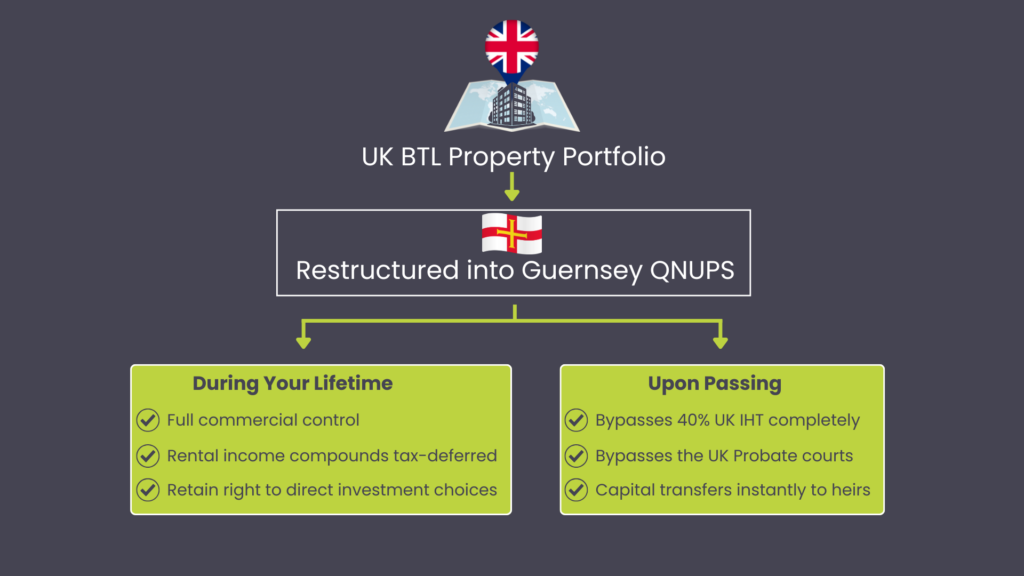
A QNUPS is an international retirement framework established in elite, highly regulated jurisdictions like Guernsey or Hong Kong. Because a QNUPS is a bona fide pension structure rather than a standard discretionary trust, it is legally permitted to hold physical, income-generating residential and commercial UK real estate.
As explicitly re-confirmed in the May 2026 HMRC Technical Update to the Pension & IHT regulations, the upcoming April 2027 legislative changes will drag domestic UK pensions into the taxable estate. However, this technical update specifically clarified that for non-UK residents, an offshore pension structure established outside the United Kingdom remains completely exempt from estate aggregation rules.
When your UK properties are properly transferred into a QNUPS, legal ownership shifts to the trustees. The assets cease to form part of your personal estate. Upon your passing, the property portfolio transfers to your chosen heirs entirely free from UK Inheritance Tax, bypassing the UK courts entirely. Furthermore, rental yields accumulate and compound within a tax-deferred environment, optimising your net returns.
2. Cross-Border Wills
To ensure that your local Hong Kong assets and your UK property never interfere with one another, you must implement concurrent, cross-border wills.
You require a specialised Hong Kong Will to govern your local corporate interests, family home, and liquid capital under HK law. Concurrently, you require a separate, standalone UK will carved out exclusively to handle any residual UK situs assets. This complete separation ensures that your family can settle your estate seamlessly, keeping your primary Hong Kong assets entirely insulated from overseas legal delays.
Tax-Proof Your UK Portfolio & Reduce Tax on UK Property as Non-Resident Landlord
As a sophisticated investor, leaving your UK property portfolio exposed to a 40% IHT liability is an unnecessary financial risk. The tools to protect your legacy are readily available and recognised by international tax law.
At Soteria Trusts, we excel at designing bespoke, multi-jurisdictional asset protection frameworks that respect your privacy and protect your global wealth. We ensure your international property investments deliver the generational security you intended.
Stop leaving your portfolio vulnerable to changing cross-border laws. Contact our specialised estate planning team directly at info@soteriatrusts.com, or click the button below to schedule a private, confidential review of your UK property exposure.
Non-residents who own UK rental properties may be able to improve tax efficiency through appropriate ownership structures, pension-based frameworks such as a Guernsey QNUPS, and careful estate planning. The right solution depends on your personal circumstances, residency status, and long-term succession objectives. Professional advice should always be obtained before making any changes.
Yes. UK residential property is generally considered a UK situs asset and may be subject to UK Inheritance Tax (IHT), even if the owner is a Hong Kong resident and has no other connection to the UK. Without appropriate planning, part of the property’s value could be exposed to the current 40% IHT rate.
A Guernsey QNUPS (Qualifying Non-UK Pension Scheme) is a regulated international pension structure that can be used as part of a wider estate planning strategy. For some non-UK residents, it may help remove qualifying assets from their personal estate while providing a tax-efficient environment for long-term wealth preservation and succession planning.
Double probate issues in UK real estate arise when an individual owns assets in multiple jurisdictions. Following death, family members or executors may need to obtain legal authority in both Hong Kong and the UK before assets can be transferred. This can create additional costs, delays, administrative complexity, and potential liquidity challenges.
In many cases, no. Changes to UK legislation mean that simply holding UK residential property through an offshore company or SPV may no longer prevent the property value from falling within the UK Inheritance Tax regime. As a result, Hong Kong landlord UK property tax planning often requires more sophisticated structures and a comprehensive cross-border estate strategy.
Yes, but only if their UK residence history is properly understood. Under the UK’s residence-based Inheritance Tax rules, a Hong Kong landlord who is not a UK Long-Term Resident will generally be exposed to UK IHT only on UK situs assets, such as UK property. However, if they have spent enough time in the UK to become a Long-Term Resident, their worldwide estate, including Hong Kong assets, may also fall within the UK IHT net. This is why UK property planning should always begin with a review of the owner’s UK tax residency history, not just their current Hong Kong residence.
Sign up for our newsletter.
Disclaimer: This article is intended for educational purposes only and does not constitute formal tax or legal advisory services. Cross-border estate regulations are complex and subject to change. Investors must consult with qualified fiduciary specialists before enacting any structural adjustments.