For high-net-worth investors and expatriates living in Hong Kong, the UK property market has long been a cornerstone for wealth creation and preservation. Whether you are a British expat holding a legacy buy-to-let portfolio, a Hong Kong national who expanded their investment horizons into London real estate, or a BNO passport holder planning a future relocation, investments in bricks and mortar continue to feel secure.
Four HMRC-recognised structures HNWIs use to protect UK property wealth from Inheritance Tax.

However, a dangerous tax trap is lurking, waiting for you to fall straight into it. The reality is stark: if you directly own residential or commercial property in the United Kingdom, your estate is automatically exposed to a devastating 40% tax on death.
With the UK’s aggressive transition toward strict residence-based taxation frameworks, understanding your exact exposure—and the institutional structures available to mitigate it—should no longer be optional. A corporate structure is now a necessity and an integral part of your investment strategy. Deciding how to structure your assets should come before you sign your first or next reservation form.
Understanding the Reality of “Situs” Assets Rules
The foundational mistake most offshore investors make is confusing personal tax residency with asset exposure. You may have zero personal UK tax liabilities on your global income, but the physical land your property sits on remains firmly inside the UK.
Under HMRC rules, UK real estate is classified as a Situs asset. This means it falls within the scope of UK Inheritance Tax (IHT), regardless of the owner’s nationality, domicile status, or country of residence.
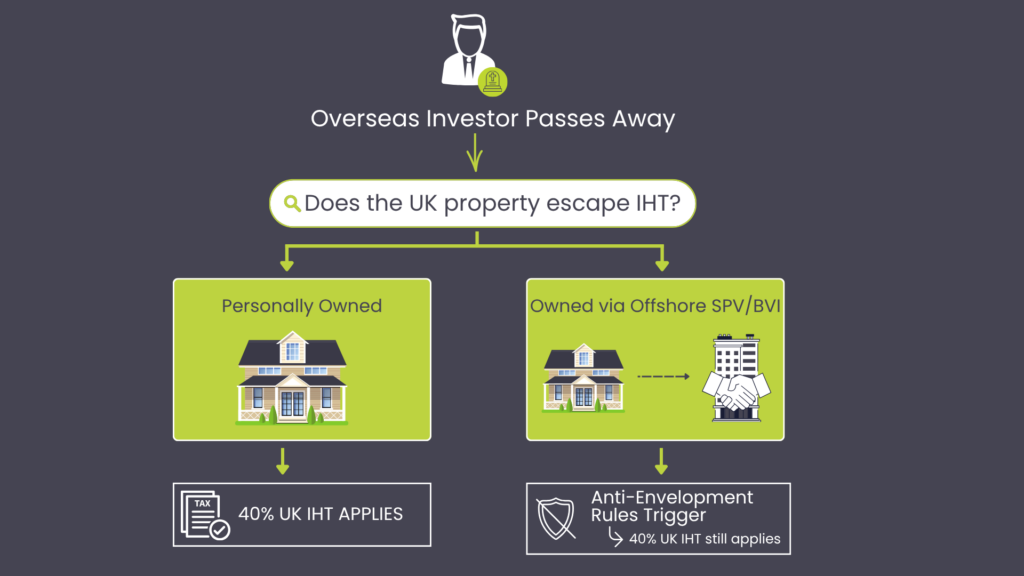
Historically, savvy investors used a strategy known as “enveloping”—holding UK property through an offshore Special Purpose Vehicle (SPV), such as a British Virgin Islands (BVI) or Hong Kong limited company. The investor owned shares in the foreign company, not the property itself.
HMRC closed this loophole entirely. Current anti-envelopment legislation pierces right through offshore corporate structures holding UK residential property. If the underlying asset is UK residential real estate, the value of those corporate shares is fully subject to 40% IHT upon the shareholder’s passing. Standard corporate wrappers no longer provide a shield; they merely add a layer of redundant administrative costs.
The Silent Multipliers: Frozen Yields and Double Probate
The financial damage of the IHT trap extends beyond the 40% tax rate. When an overseas landlord passes away without cross-border restructuring, their family faces immediate operational chaos.
- Frozen Rental Income: UK bank accounts and letting agency disbursements are immediately locked upon notification of death. Tenants cannot legally pay rent into frozen accounts, and property managers cannot release yields to beneficiaries in Hong Kong.
- The Double Probate Nightmare: A standard Hong Kong will cannot be used to directly manage or sell UK real estate. Your executors must go through the gruelling process of “Double Probate.” They must hire UK solicitors, petition the UK courts for a Grant of Representation, and endure months—or even years—of administrative delays.
- The Liquidity Squeeze: Crucially, HMRC requires the 40% inheritance tax to be paid before probate is granted. If your family does not have hundreds of thousands of pounds in liquid cash readily available to satisfy the tax bill, they cannot gain legal title to the property to sell it or refinance it.

Institutional Shields: How HNWIs Protect UK Property Wealth
Leaving your hard-earned wealth to chance is a severe risk. To secure your assets and protect your family, you must transition away from exposed personal ownership and outdated corporate structures.
Advanced wealth planning relies on HMRC-recognized, cross-border frameworks to legally neutralise your IHT exposure.
1. Qualifying Non-UK Pension Schemes (QNUPS)
A QNUPS is an internationally recognised retirement structure established in highly regulated, tax-efficient jurisdictions like Guernsey or the Isle of Man. Because a QNUPS is a bona fide pension structure rather than a standard trust, it can legally hold physical, income-generating UK residential real estate.
When property or purchasing capital is properly structured within a QNUPS, the asset ceases to form part of your personal estate. Upon your passing, the property passes smoothly to your chosen beneficiaries entirely free from UK Inheritance Tax, bypassing the probate court bottleneck completely.

2. Private Placement Life Insurance (PPLI) & Tailored Life Solutions
For portfolios backed by substantial cash reserves, global equities, or liquid assets generated by property yields, Private Placement Life Insurance (PPLI) acts as an institutional “insurance wrapper”.
By placing investment assets inside a PPLI structure, you create a robust tax-deferral environment. It effectively freezes capital gains and dividend taxes, shielding your global wealth from the UK’s strict 10-year residency rules if you choose to relocate.
Concurrently, a high-value, cross-border Life Insurance policy can be structured to sit alongside your property portfolio. The policy is explicitly designed to pay out an instant, tax-free cash lump sum directly to your beneficiaries upon your passing. This provides the exact liquidity your family needs to settle any unavoidable tax debts immediately, preventing a forced fire-sale of your property.

3. Family Investment Companies (FICs)
For generational portfolios, a Family Investment Company (FIC) offers an elite alternative to traditional trust frameworks. A FIC is a bespoke corporate structure established to hold wealth while shifting asset value out of your personal estate.
By retaining voting shares, you maintain absolute control over the management and income of the property portfolio. Meanwhile, non-voting shares representing future capital growth are transferred to your children or heirs. This structured approach dilutes your personal IHT exposure over time while keeping asset control firmly in your hands.
4. Cross-Border Will Writing
No international estate plan is complete without asset segregation. Relying on a single, generic Will to cover multiple tax jurisdictions is a recipe for severe probate delays.
High-net-worth individuals require concurrent, cross-border wills. A dedicated Hong Kong Will to govern local corporate and liquid holdings, and a separate, UK-compliant Will carved out exclusively to govern UK situs assets. This ensures seamless execution, protects your family’s privacy, and prevents cross-jurisdictional legal friction.
The Rules Are Changing
The UK tax landscape is moving at an unprecedented pace, and overseas property owners are a primary target for revenue generation. If your portfolio relies on personal ownership or basic offshore SPVs, your legacy is vulnerable to a 40% reduction.
Cross-border asset protection is a specialised discipline. At Soteria Trusts, we do not believe in one-size-fits-all solutions. We design tailored, multi-jurisdictional strategies to insulate your wealth, eliminate tax burdens, and ensure your legacy transfers seamlessly to the next generation.

At Soteria Trusts, we help clients combine QNUPS, trusts, FICs, PPLI, insurance, and international pensions into a cohesive, compliant strategy that reduces UK IHT exposure — today and for the next generation.
Disclaimer: The information provided in this article is for general educational purposes only and does not constitute formal legal or tax advisory services. Cross-border tax regulations are subject to frequent change. Investors must seek personalised legal and fiduciary guidance tailored to their specific financial circumstances before implementing any structure.
No — not with the structures used here. With a QNUPS, the scheme itself becomes the legal owner, but you can still act as a trustee or scheme member with oversight of how assets are managed. With a Family Investment Company, you retain voting shares and full control over management and income decisions, while only the future growth (via non-voting shares) passes to your heirs. Control and IHT protection aren’t mutually exclusive when the structure is set up correctly.
Not on its own. A basic offshore SPV holds the property, but the shares in that SPV are still typically part of your personal estate and remain exposed to UK IHT. The structures above go a step further — a QNUPS or FIC is specifically designed to move the underlying value out of your estate, not just change whose name is on the title deed.
They solve different problems. A QNUPS is built to hold the physical property itself, removing that specific asset from your estate. A PPLI is better suited to cash, equities, and liquid assets — including rental income you’ve generated — wrapping them in a tax-deferral structure. Many HNW portfolios use both together: QNUPS for the real estate, PPLI for the liquid wealth it produces, plus a life insurance policy layered in to provide immediate liquidity for any tax due on death.
Yes, in most cases. A single Hong Kong will covering UK situs assets can create serious probate delays, since UK assets typically need to go through the UK probate process regardless of what your HK will says. A dedicated, UK-compliant will carved out for UK assets runs alongside your HK will, letting each be executed in its own jurisdiction without one holding up the other.
That’s exactly what a private estate evaluation is for. Every portfolio’s exposure depends on your residency status, how your assets are currently structured, and which jurisdictions are involved — there’s no generic answer. Soteria Trusts’ cross-border planning team can review your specific holdings and map out where your exposure sits today, and which of these structures (or combination of them) would address it.