For experienced property investors, wealth managers, and expatriates based in Hong Kong, the mechanics of UK Inheritance Tax (IHT) are familiar territory. You already know that the standard 40% death tax catches your UK residential and commercial properties because they are classified as situs assets. You are also fully aware that holding these investments through an offshore Special Purpose Vehicle (SPV), such as a British Virgin Islands (BVI) or Hong Kong limited company, does not circumvent the tax net under the UK’s anti-avoidance rules.

However, the legal landscape governing your wealth has fundamentally transformed. The UK has shifted decisively to a residence-based tax framework.
The primary challenge is no longer just identifying the 40% liability. It is adapting your structures to survive the rigid 10-year long-term residence (LTR) rule while navigating the massive overhaul of pension and corporate wealth structures.
Understanding how to maintain your current lifestyle without inviting HMRC scrutiny requires examining several key institutional options.
The New UK Residency Rules: 10-Year Exposure
Under the updated residence-based framework, a clear distinction must be made based on your specific residency status:
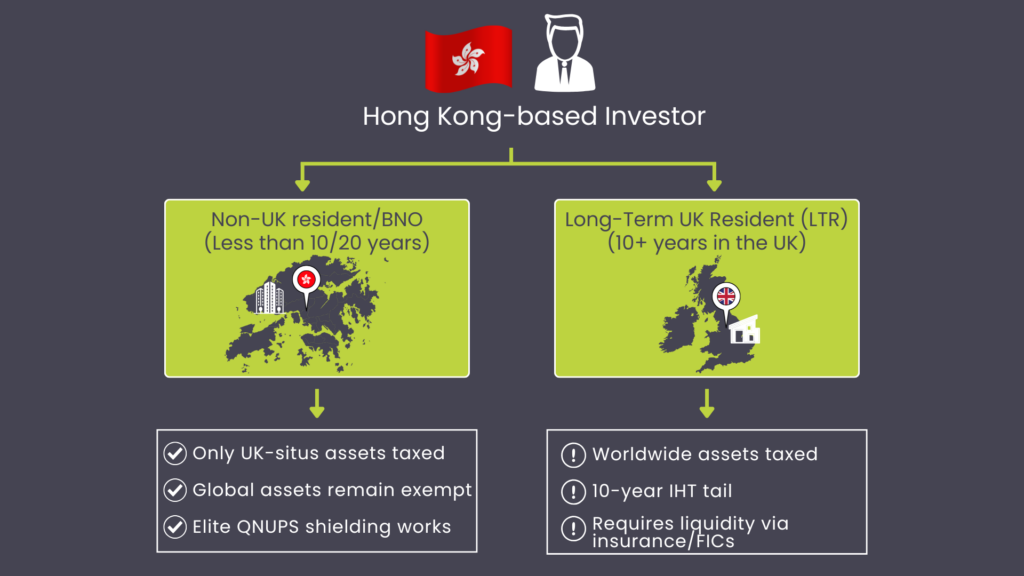
The Non-UK Resident / BNO Client: If you remain based in Hong Kong or have been in the UK for fewer than 10 out of the past 20 tax years, your global assets, business holdings, and local liquid funds remain entirely outside the UK IHT net. Only your UK real estate portfolio, along with any other UK assets you own, is exposed.
The Long-Term Resident (LTR): Once you cross the 10-year residency threshold, the UK tax net claims jurisdiction over your worldwide estate. Furthermore, leaving the UK triggers an extensive 10-year structural tail, meaning your global wealth remains exposed to HMRC for up to a decade after you repatriate to Hong Kong.
QNUPS for Non-UK Residents: The Definitive Compliance Route
While standard domestic pension planning has faced severe restrictions under the Finance Act 2026, Qualifying Non-UK Pension Schemes (QNUPS) remain an exceptionally viable option to shield wealth—provided they are used by non-UK residents.
As confirmed in the May 2026 HMRC Technical Update to the Pension & IHT regulations, the upcoming April 2027 rule changes will bring unused domestic UK pensions into the taxable estate. However, this update specifically clarified the parameters for cross-border planning. For non-long-term UK residents, an offshore pension established entirely outside the United Kingdom remains explicitly exempt from the 40% IHT estate aggregation rules.
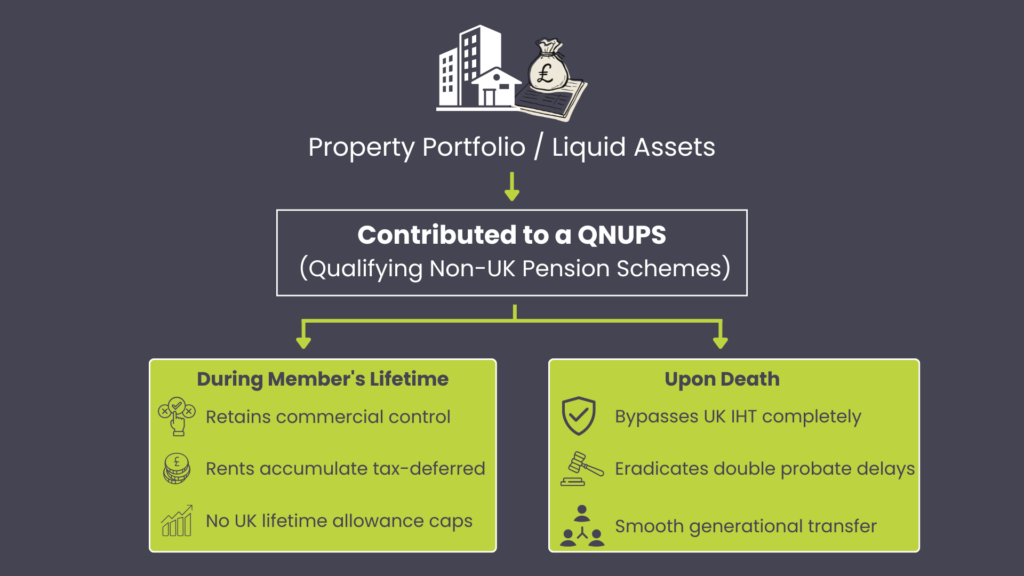
By utilising a QNUPS established in a premier financial centre like Guernsey, non-resident investors can place physical UK real estate or purchase new assets directly into the scheme. Because the asset is legally owned by the trustees of a bona fide international retirement structure, it ceases to form part of your personal estate.
- The Result: The property is insulated from the 40% IHT liability. Rental returns compound within a tax-deferred environment, and upon passing, the entire portfolio transfers to your named beneficiaries without being frozen by the UK courts.
Advanced Toolsets: PPLI, Life Insurance, and FICs
For those with high-value portfolios that require a broader approach beyond property assets, an optimised strategy can utilise a mix of complementary financial instruments and asset classes.
1. Private Placement Life Insurance (PPLI)
For investors managing substantial liquid wealth, cross-border corporate positions, or investment portfolios, a PPLI acts as an institutional insurance wrapper. By placing global equities and liquid cash reserves inside a PPLI framework before crossing the 10-year UK residency threshold, you create a robust tax-deferral shell. It effectively insulates your global growth from UK Capital Gains Tax (CGT) and income tax brackets, freezing your tax exposure until deliberate distributions are executed.
2. High-Liquidity Life Insurance
The greatest logistical risk to an estate is the liquidity squeeze. Because HMRC demands payment of the 40% IHT bill within six months of death—and crucially, before UK probate is granted—families are often forced into a fire-sale of properties to clear outstanding debts. A dedicated, cross-border Life Insurance policy resolves this tension. Structured correctly, the policy triggers an immediate, tax-free cash payout directly to your beneficiaries. This provides the exact liquid funds required to satisfy HMRC, preserving the integrity of the property portfolio.
3. Family Investment Companies (FICs)
For generational real estate portfolios where control must be preserved, a FIC is a highly efficient alternative to traditional trust structures. By setting up a bespoke UK corporate entity, you retain absolute management control through voting shares. Meanwhile, the underlying capital growth value is safely transferred to your heirs via non-voting shares. This enables a gradual reduction of your personal IHT footprint while preventing younger generations from mismanaging the underlying assets.

4. Cross-Border Wills and Probate Ring-Fencing
Relying on a single, global will to manage assets across multiple legal frameworks is an administrative error that guarantees frozen yields. Sophisticated estate management requires concurrent, cross-border wills:
- A local Hong Kong will to govern local corporate holdings and local liquid capital.
- A separate, standalone UK will drafted exclusively to govern UK situs assets.
This prevents cross-jurisdictional legal gridlock, guarantees that property management can continue uninterrupted, and ensures your executors do not get trapped in multi-year probate disputes across separate court systems.

Securing Your Structural Legacy
At Soteria Trusts, we reject generic, one-size-fits-all products. We focus on the engineering of multi-jurisdictional wealth structures designed to withstand regulatory changes. Our team works to shield your assets and ensure a seamless generational transfer.
The transition toward a residence-based tax net means legacy planning strategies must be continuously reviewed. If your UK investments remain exposed through personal titles or basic offshore companies, they are vulnerable to a significant tax reduction.
Evaluate the resilience of your current corporate and property structures. Contact our cross-border planning specialists directly at info@soteriatrusts.com to schedule a private, technical review of your estate’s exposure.
Sign up for our newsletter.
This article provides general information only and does not constitute tax, legal, or financial advice. UK tax rules are complex and continue to evolve; individuals with UK tax exposure should seek advice tailored to their specific circumstances from a qualified UK tax adviser alongside their trust and fiduciary planning team.